About a month or so ago, the playtesting rules for Striketeam and Battlezone Commander were released on their Kickstarter. With a friend also interested in giving Striketeam a go, I of course had to first properly prepare Scourge and PHR lists:
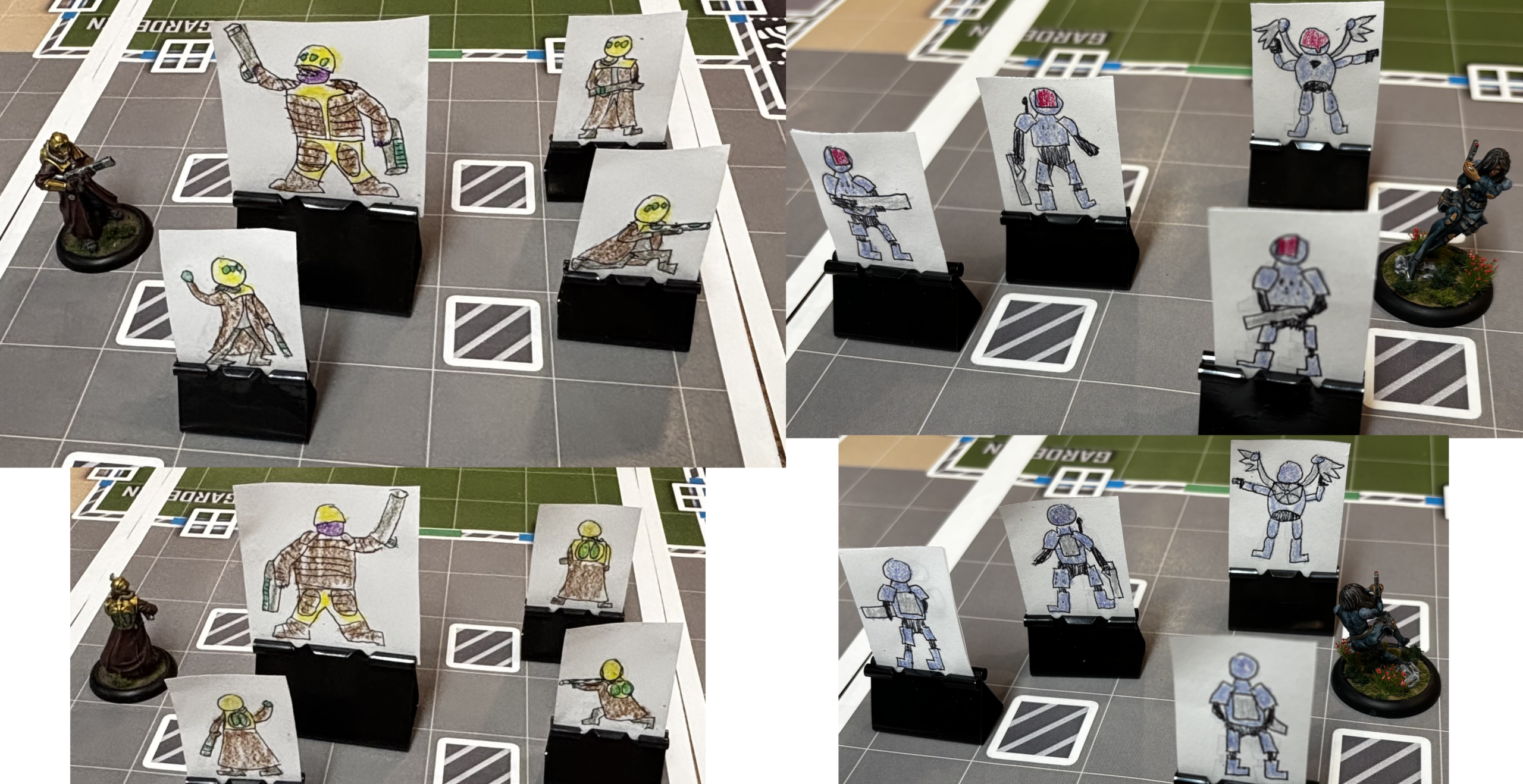
While I could have simply used some sort of featureless tokens, that would take out a great deal of the fun and deny the world these artistic masterpieces.
A first read through of the rules revealed a number of small questions that needed answering; nothing game breaking, but absolutely another indication of the need for proper technical writing passes on their rule sets to toss on the pile that necessitated some “yeah it’s probably intended to be like this” calls. Regardless, it did seem to capture the feel of a close quarters interior fight on first impression, so I went in at least optimistic that it would be interesting to try.
The next step was to print out the map itself. The rules come with two maps at the moment, each with a few specific scenarios, so I just went with the first map (Hotel Lobby) and planned for the first mission (Breaking and Entering). After wasting over an hour at work and far too much paper getting the pdf to print and tile properly and then cutting and taping it all together, a proper 20×30 grid of squares was complete! As the game uses a grid system for all movements and measurement, in theory the squares could be as small or large as you wanted, but as-is they’re 30mm, resulting in a roughly 2×3′ board.
A board with squares does immediately give off ‘board game’ vibes in my head, distinct from ‘miniature game’. What delineates a miniature game as distinct from a board game isn’t the most strictly defined thing, but to me I picture the latter as a more constrained but tightly designed system that’s self-contained, while the former approaches a game with an emphasis on narrative/imaginative experience and self-expression, regardless of whether the playing pieces are miniatures in both. The presence of list building alone is shifting things more towards ‘miniature game’ in my mind at least, as that’s where you tend to get a lot of the player self-expression in a game, but ultimately this is just engaging in silly nerd taxonomy that’s mostly based on preconceptions of what to expect out of a game going into it that should be put aside if you wish to judge something on its own merits.
Something I would be interested in learning more about is what sort of skirmish-style miniature games are out there that use a grid like this to see if they have any clear inspirations for game design. Off the top of my head, there’s Deadzone from Mantic, although I recall that uses more of a ‘cube’ system. Interestingly, the whole thing with small squads fighting on a square grid reminds me of XCOM, and a miniature game for that was just announced. I don’t play too many video games, but I did spend a fair while on the 2012 XCOM game when that came out, so it’ll be neat to see how much they translate of that to the tabletop.
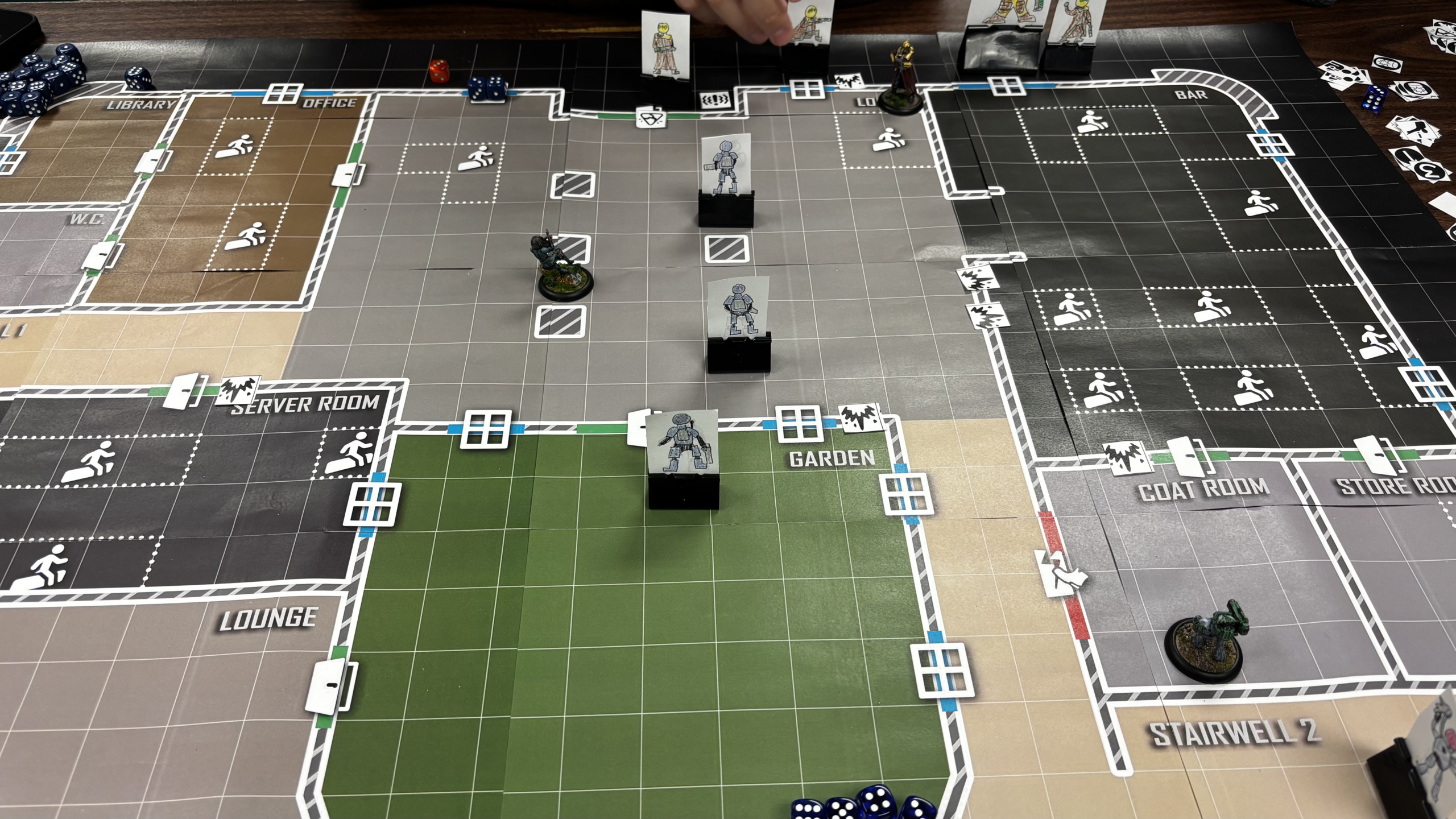
I played PHR as the defender:
- Immortal Commander
- Immortal
- Immortal
- Siren Gunner
- Valkyrie
Versus Scourge as the attacker:
- Warrior Prime
- Warrior
- Warrior
- Warrior with Shard Rifle
- Demolisher
We got to round 4 of 8 before talking through the likely way the rest of the game would play out, calling it as a 3-2 PHR victory, as I was running out of free time.
Unit and faction identity felt properly represented. My Immortals were slow and had a long range but unremarkable gun, and also refused to die thanks to their defensive stats and smoke grenades. My Siren was a highly mobile and damaging unit that was hard to pin down, until she took a grenade to the face. My Valkyrie moved quite quickly but also accomplished nothing of note because of where I decided to deploy her. The Warriors had potent weapons, and the Demolisher was a big hunk of meat that was the last attacking unit left standing.
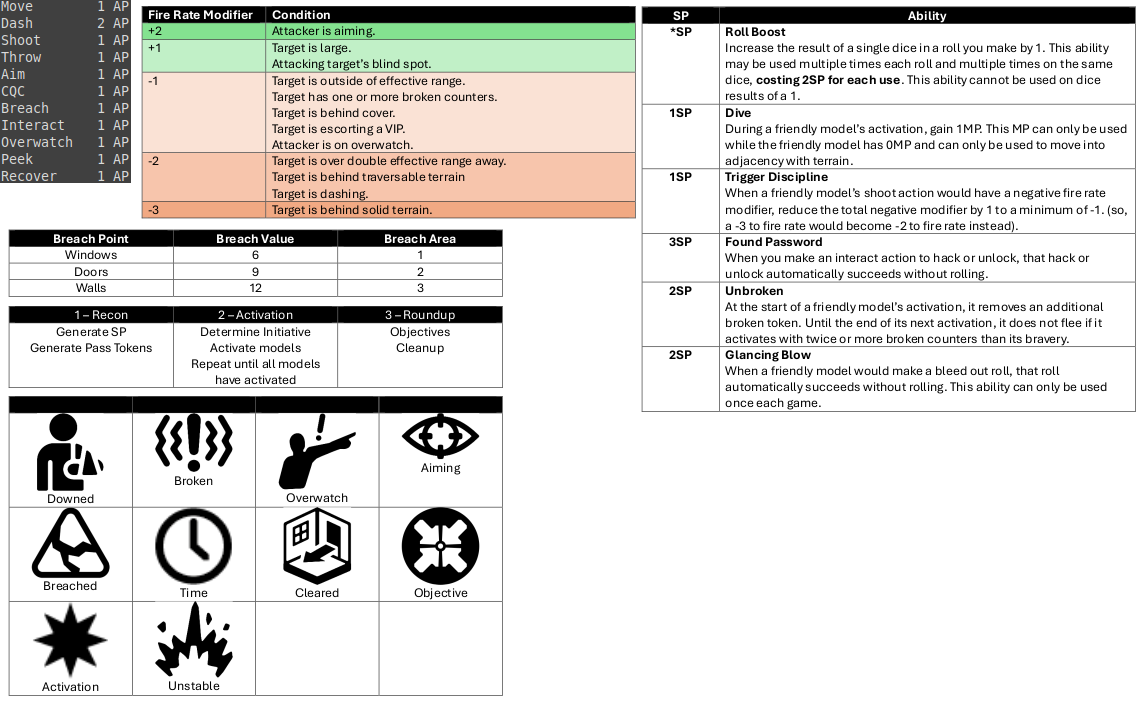
Breaching was thematic and smoke grenades were powerful tools. There’s ability/command/skill/whatever you want to call them points for abilities, mostly generic but some specific to commanders, and I’m glad that they swapped the generic re-roll ability of Dropfleet for a roll boosting ability: 2 SP for +1 to a roll, repeatable but with some limitations, is smoother and faster than re-rolls. Diving and dashing around fit in nicely. I like that there’s some asymmetry with attacker and defender roles. Having to finish off a downed unit with a coup de grâce or moving on and risking it recovering and flanking you provides some pressure on your actions. The initiative system was a bit confusing at first but worked well once we understood it.
The scenario itself could use a small redesign in my opinion. There’s little reason to engage with the left side of the map, as the primary goal is to capture the VIP being held in the coat room on the right side of the map, represented by the most important possible character: a Pungari. Something that either requires or heavily incentivizes the players to be on the left side of the map as well would make it more interesting, as opposed to a big clump of a rush towards Dr. Pungari as things stand.
Speaking of scoring, the relative value of secondary objectives in Striketeam is noteworthy. By comparison to Dropfleet, in which the secondaries usually serve more of a tiebreaker role given their value relative to the points you can typically score in a scenario, in Striketeam getting all the 4 secondary objectives in a given scenario can be nearly equal to, or exceed, the value of the main objective itself. I’m concerned it’s possible optimal play for some scenarios may turn into faffing about and focusing on your secondaries as a result!
I’m not going to go through the whole set of rules to dissect pain points, but here’s a few examples to demonstrate what sort of problems are present at the moment. First, the interaction of solid terrain, and specifically smoke in particular which provides temporary solid terrain that can be moved through, with shooting, due to three rules:
- A square is not considered adjacent to itself.
- While drawing line of sight to fire, you ignore adjacent solid terrain. If the line passes over any other solid terrain, there is no line of sight and you can not shoot to the targeted square.
- When measuring between squares, measure center to center.
To illustrate:
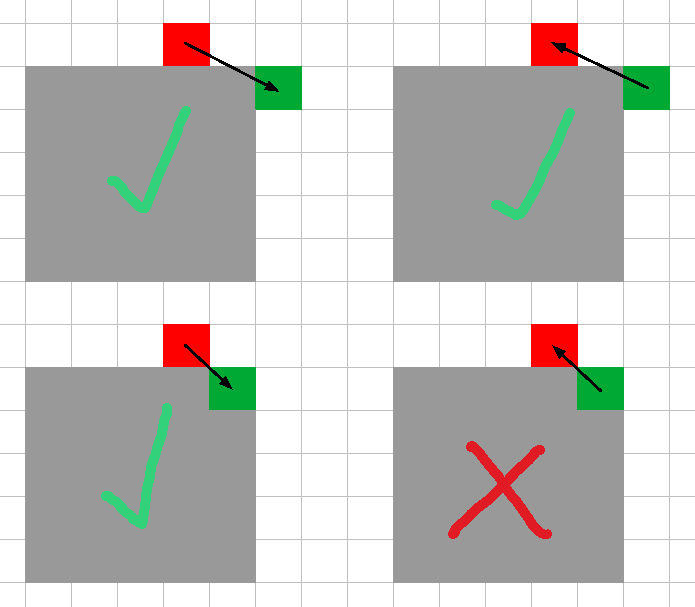
Gray is smoke, the red and green are opposing units, and the black arrow is the firing line. It’s possible to end up in a situation where a unit standing in smoke can not fire on a unit standing adjacent to it but outside smoke, as you begin to measure your firing line of sight from the center of the smoked square, which isn’t ignored as it’s not an adjacent square, but is solid terrain, and are therefore immediately unable to draw line of sight. However, the opposing unit can ignore that smoke/solid terrain as it’s adjacent, and fire unopposed! You could still CQB, but often that’s not something you necessarily want to do versus shooting.
I won’t mention how this nonsense sent me down a rabbit’s hole reading about line algorithms to see if there was a way to easily determine exactly what squares get crossed over. A laser level is almost certainly going to be necessary to play if you want to be accurate as the rules stand.
Another related question was how units standing on opposite sides of a piece of solid terrain fire at each other:

It’s clear if you use Peek, you can fire without issue, but can you fire directly through the solid terrain piece as it’s ignored? Is it only ignored for the initial line of sight drawing, so you can still fire but suffer a penalty to your fire rate, or is it completely ignored for all purposes?
On the topic of fire rate, which is the number of dice a weapon rolls to attack, this one was a bit more clear (I think…) in the intention, but definitely needs some touching up. As one example:
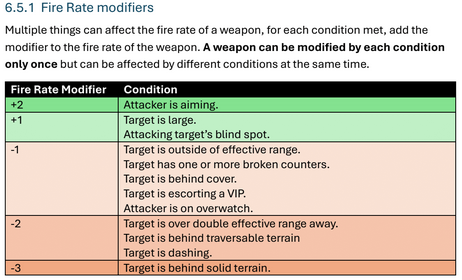
Do you spot the issue?
A target that’s double effective range away is also outside effective range! Is it supposed to stack to a -3 FR modifier? As read, yes, that is how it’s worded… but it’s felt very odd when reading and thinking it over. For clarity’s sake, I’d like to see a cleaner way to write this up.
They’ve got a feedback form for the rules, but unfortunately you need to provide specifics of a game you played to enter any more general feedback like this that can arise as evident problems from reading only. I think it’s reasonable to prioritize feedback from people who have actually played it, but as it is I wouldn’t be surprised to see people put in false data on the required game information just for the sake of getting to the general feedback text boxes.
Despite the criticisms, there were things I enjoyed enough about it that I at least want to play again with a different scenario to get a better informed opinion on the game. The Pincer Attack scenario that uses the room clearance objective looks like it could be fun, as it should involve a lot of individual units splitting up and running around, contrary to the VIP scenario we tried that encouraged us to keep the team together.
Also, I tossed together a quick reference sheet that might be useful for anyone testing the rules as they stand:
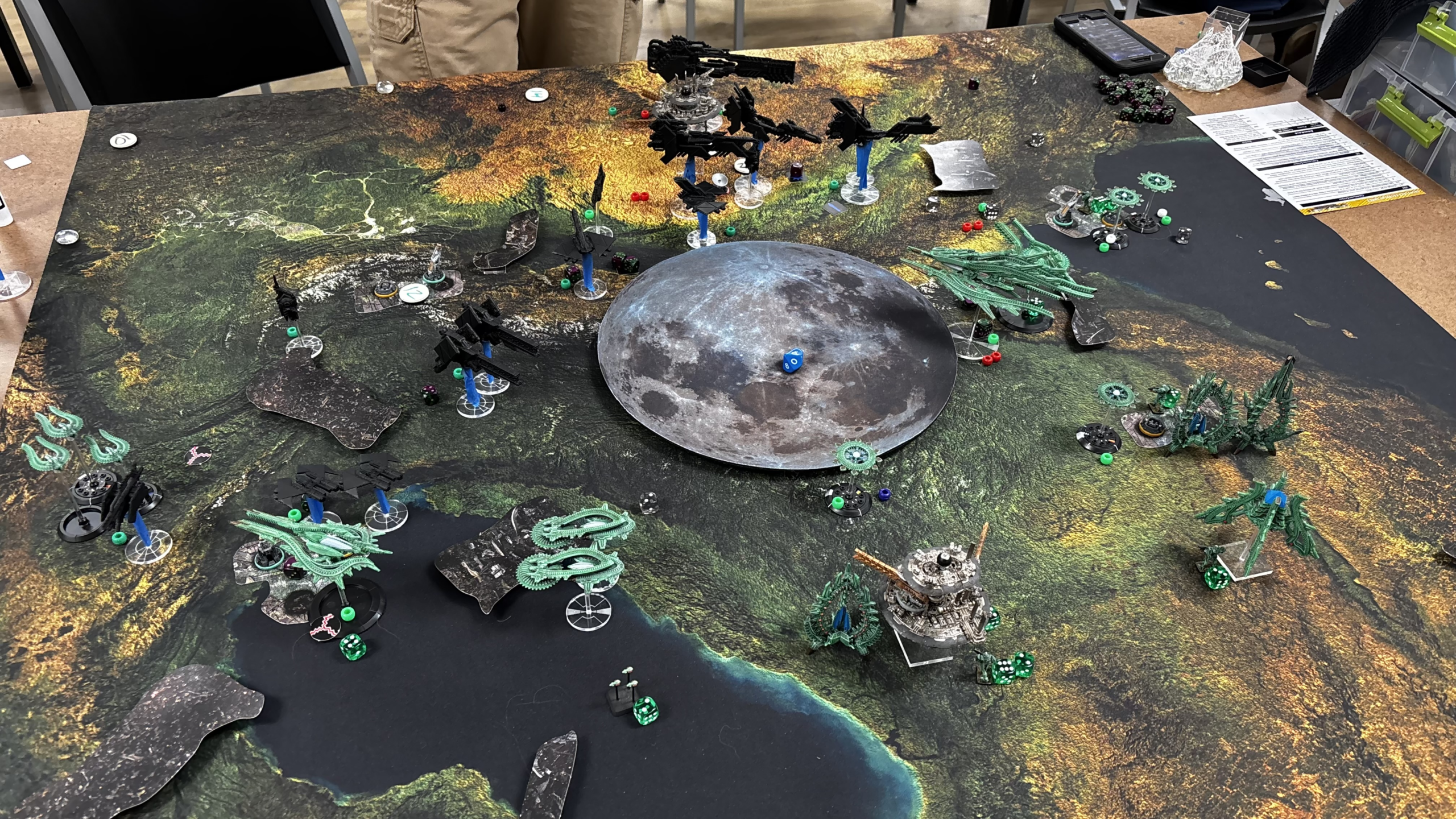
End of last month was the most recent Dropfleet game I played, Shaltari v Bioficer. It was a tie but I lost on kill points, as by the end I think the only things I had alive were my Cobalts, Heliums, and a few Void Gates. The cells were interesting to play against; I felt a lot of pressure to keep the Genitor Towers off the dropsites in particular, which I successfully did, but I underestimated the firepower coming out of the fleet and lost too much in retaliation.
Two notable things about the game! First, I proxied some things to test out the new features. One ship carrying two Stellargates, and one with a Stellargate and Worldstrider. The Stellargates felt a little too powerful, though not overwhelmingly so: extending the gate chain, launching fighters/bombers, and adding a battalion every round is a lot to do at once. I intended the Worldstrider to be a counter to any Genitors that made it down, so the carrier was prioritized and shot down before it could land it. Thankfully as mentioned, I didn’t need it, thanks to killing off the Genitor-carrying frigates with the other new thing: Mines! I took two Basalts, both with mines, and dumped a significant pile of them over the contested dropsites. They worked rather well in this situation versus taking equivalent bombers, as they interdict in the middle of an activation and can destroy a ship before it gets to shoot or launch, while bombers would have to wait for the asset phase. I liked them quite a bit as a result, but they do feel very scenario-dependent in their usefulness.
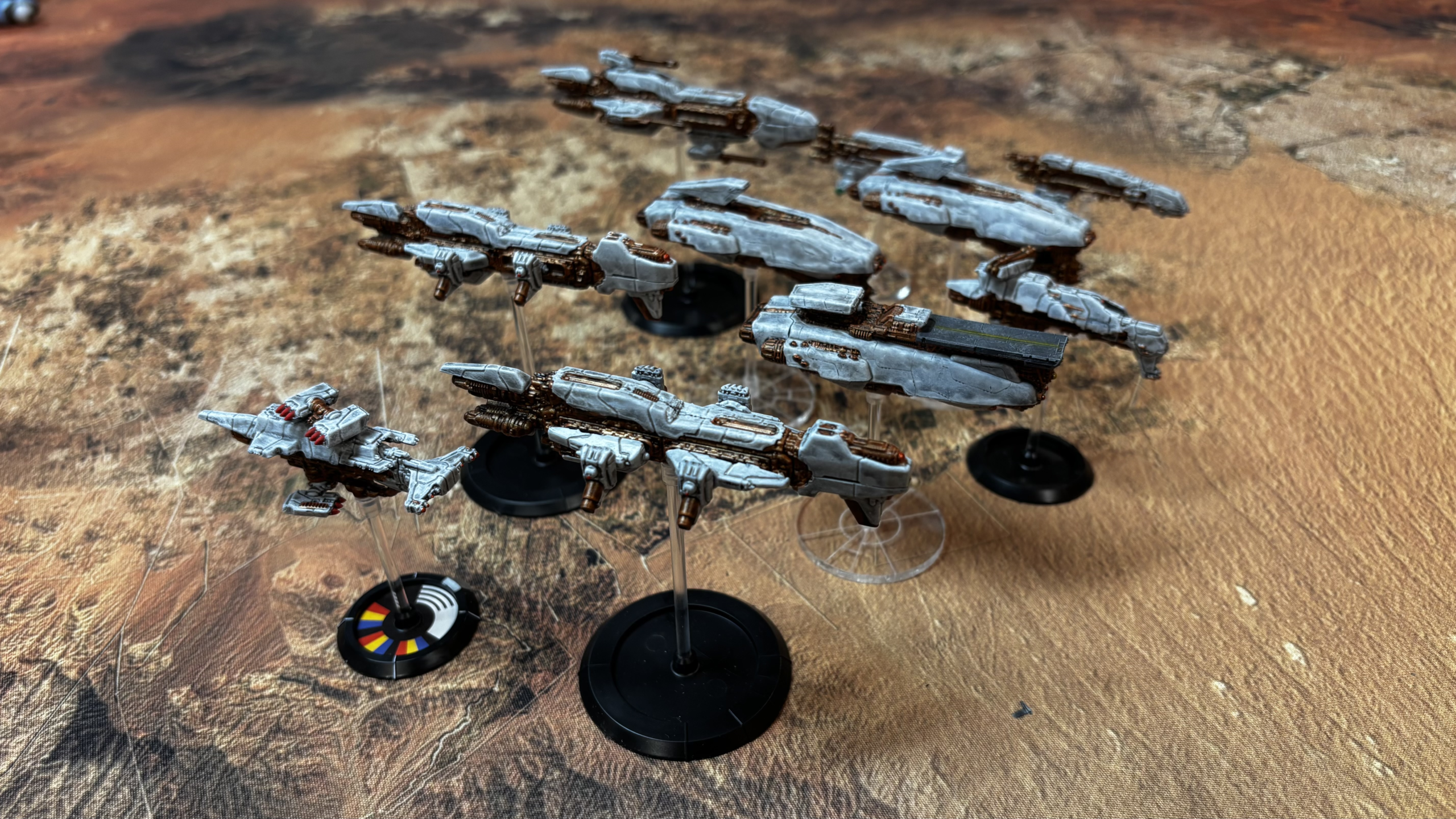
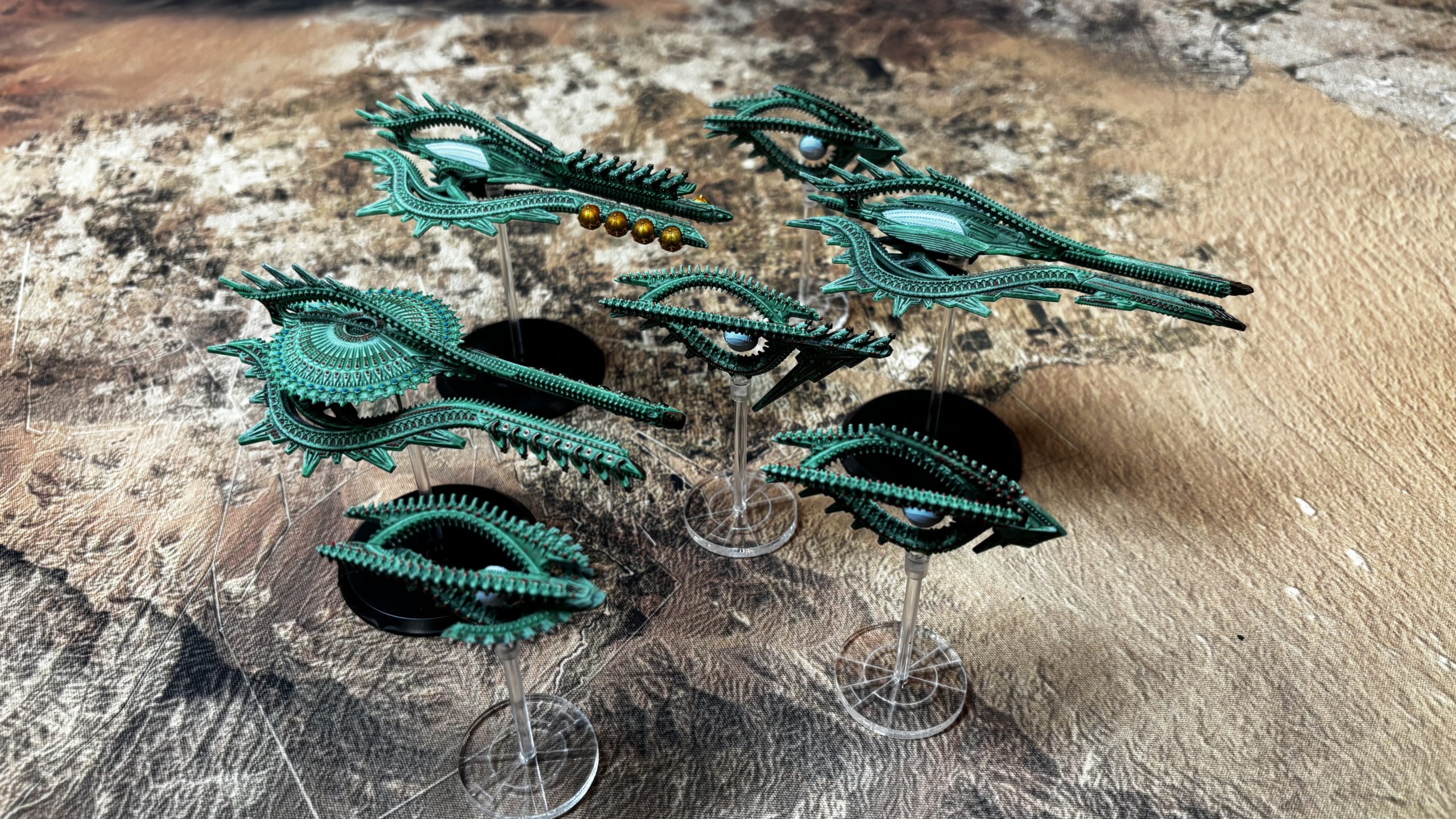
Painting-wise, I wanted to round out the last bits of my Resistance and Shaltari I felt were missing prior to the new battlecruisers. Enough frigates for each to either make maximum groups or field two minimum groups of a particular class. Then bombardment cruisers for Resistance and a Jet for Shaltari, as both needed a few more options for that in this upcoming feature-filled world, a second gun cruiser for Resistance because why not, and a Citrine and a Basalt for Shaltari to be satisfied with cruiser coverage on them. Finally, Armstrongs as the debris clearance rule seems neat, and a second Collins so I can have two of each destroyer variant.
On a final Dropfleet note, I was reminded of something with the recent release of the plastic PHR battlecruisers. When the Agrippa/Pompeius first came out, included in the PDF for their rules was an image you could print out to use as your holo-field. The picture vanished from the rules and website at some point afterwards, but I quite like the image and would like to preserve it for others to use. It’s significantly larger in the pdf than the 4″ diameter circle it is in the rules at present, but scaling it down while printing should get you to the right size. I intend to get some MDF discs or something like that to glue it onto.